
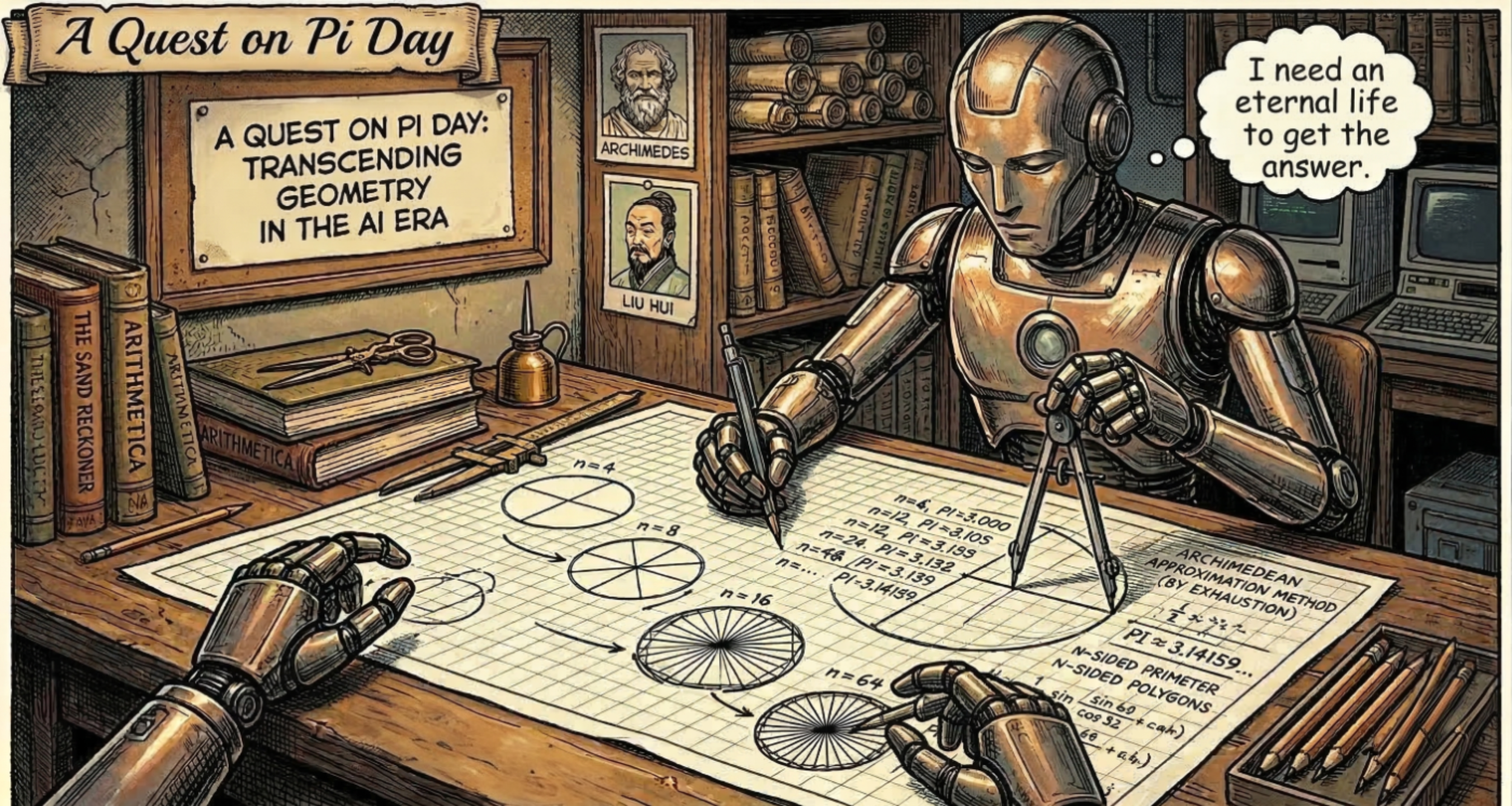
a quest on pi day: transcending geometry in the ai era
Happy Pi Day! Let’s have a historical review on how Pi relates to human civilisation.
Today, March 14, is Pi Day — the most widely recognized date for the general public to commemorate mathematics. While almost everyone associates π with the number 3.14, mathematics learners know its reach extends far beyond the ratio of a circle’s circumference to its diameter. π is a foundational constant of complex analysis, which in turn serves as the theoretical bedrock for modern signal processing. Finding the exact value of π is one of the oldest problems in human civilisation, and exploring its multifaceted nature remains a powerful dynamo in mathematical development.
Nearly all ancient civilisations approached π as a practical engineering problem: how to construct circular objects using rectilinear measurements. If the diameter of a circle was measured precisely, its circumference became frustratingly "immeasurable." Our ancestors settled for approximations—such as 3, the fraction 22/7, or 3.14. Practically speaking, this was sufficient. Because a metaphysically perfect circle cannot be physically constructed, a good approximation satisfied the engineering needs of the day.
However, mathematical minds thought differently, questioning whether π was truly immeasurable even in a theoretical sense. The ancient Greeks posed a famous geometric challenge: using only a compass and an unmarked straightedge, could one construct a square and a circle of the exact same area? It took nearly 2,000 years to prove this mathematically impossible by German mathematician Ferdinand von Lindemann in late 19th century, who at the same time proved that π is transcendental — meaning its value cannot be derived through a finite sequence of arithmetic operations and root-takings. If the discovery of irrational numbers sparked a philosophical crisis for the ancient Pythagoreans, the transcendentality of π would have been utterly paradigm-shattering.
As algebra and calculus matured, mathematical minds began viewing π through entirely new lenses. In antiquity, Greece’s Archimedes and China’s Liu Hui used iterative regular polygons to approximate π. While geometrically elegant, it was computationally exhausting. The birth of calculus in the 17th century introduced infinite power series, a vastly more efficient tool. Over time, increasingly mysterious and efficient series were developed, culminating in the early 20th century with the work of Srinivasa Ramanujan. Ramanujan, who famously claimed his formulae were revealed to him in dreams by a goddess, produced series of astonishing complexity and speed, highlighting a critical concept in modern mathematics: the order of convergence.
Simultaneously, the great Leonhard Euler connected π to the geometry of rotation. By bridging radian notation with complex numbers, Euler transformed geometry into analysis. Through Euler's formula,
$$e^{ix} = \cos(x) + i\sin(x)$$
the wave properties of the physical world could be elegantly represented using complex exponential and trigonometric functions. Waves could now be manipulated, approximated, and compressed analytically, giving birth to modern signal processing.
Today, we know we can never represent the exact, finite value of π. Therefore, the modern challenge is maximising accuracy within a limited computational timeframe. On the other hand, when it gets to an approximated value correct up to billions of digits, whether the resources used to save and manipulate each digit would overflow is another edging problem in computer science. For example, Liu Hui’s dissection method involves a lot of computation involving square root taking. This will definitely cause a huge problem in computers if an algorithm is developed accordingly: The calculated value had to be truncated at some point, creating an accumulative error in the computation as the algorithm goes on. It also drains processing power.
Therefore, computer scientists rely on algorithms built purely on integer addition and multiplication. By expressing infinite series through Linear Fractional Transformations, the computation of π can be reframed into a recurring relationship of matrix multiplications. Because the arithmetic of fractions can be cleanly represented by 2 X 2 matrices, the entire algorithm can run using exact integer matrices, with only a single division operation occurring at the very end to yield the final digits.
Coincidentally — or perhaps consequently — the computational framework driving the neural networks of the current Artificial Intelligence boom is also based on massive matrix multiplication. It is a miraculous, elegant convergence: the exact same structural mathematics used to chase the infinite digits of humanity's oldest geometric constant is now powering the cutting edge of our technological future.
Disclaimer: Original ideas by the author, with language polished by AI tools.
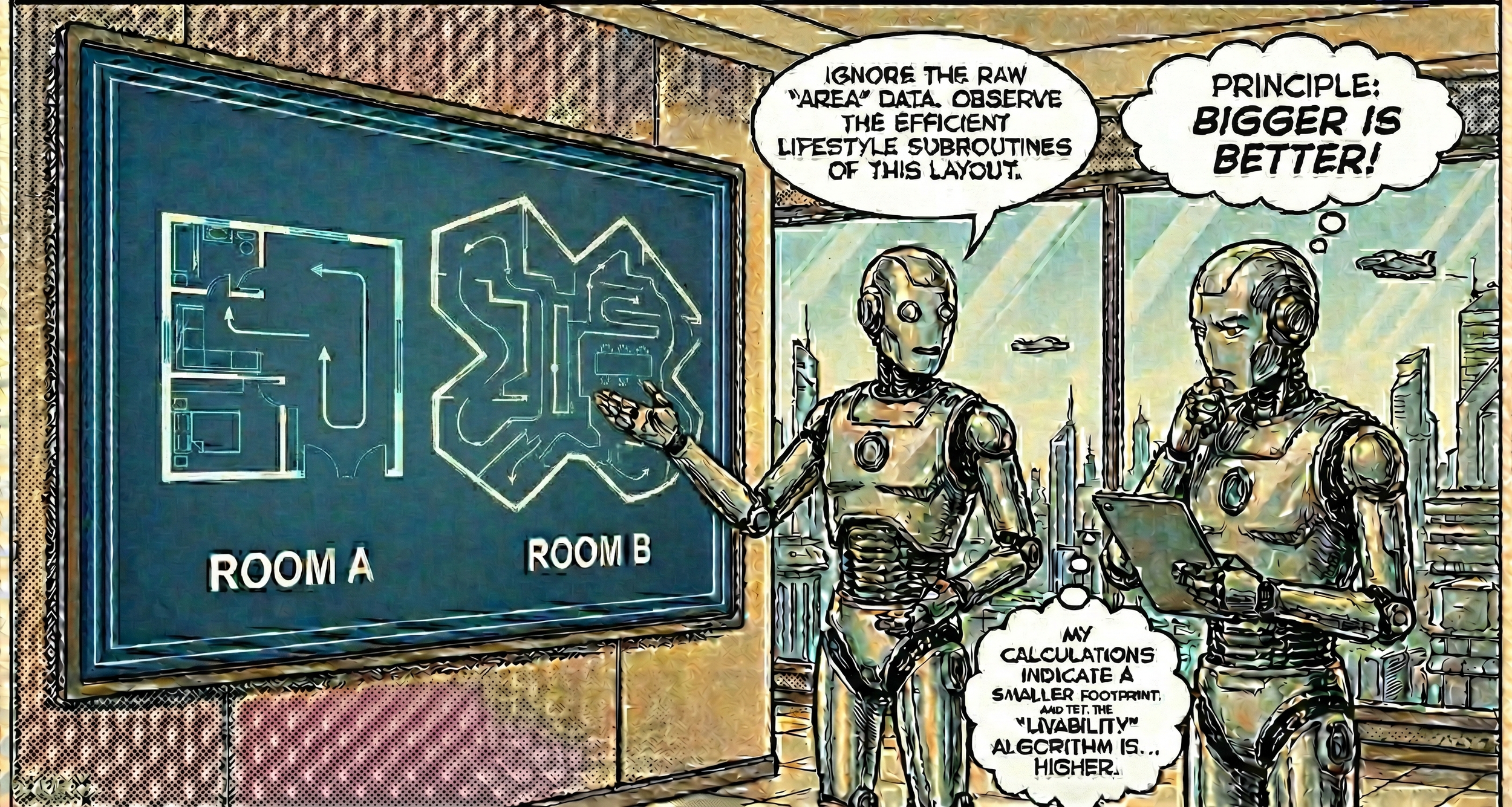
The Illusion of Area: What We Forget to Teach About Mathematics
In many real life problems involving the sizes, it usually involves more factors that sizes alone, and all factors affect our decision making.
Sometimes, as mathematics educators, we place too much emphasis on the power of universality and abstraction in solving problems. We praise mathematics as everlasting—that what our students learn in lessons is rooted in knowledge from thousands of years ago, yet remains vital in solving current real-world problems. "The Mother of Science," we proudly proclaim.
All of this is true. However, we often intentionally or unintentionally omit one key feature that makes mathematics everlasting: the process of abstraction. In any branch of mathematical study, we basically isolate a small fraction of an object's features and strip away the rest, allowing us to focus on one thing at a time. These isolated features are then defined with clear terms and logical consequences, providing a common ground for discussion that spans millennia. By following these established logical and operational rules, one does not need to possess an extraordinary mind to understand and solve some of the hardest problems of ancient human civilisation. That is why we want our students to learn mathematics.
But what is equally important is what we omitted: recognising that mathematical descriptions of patterns and behaviours are limited, and have a fine yet significant distinction from the real world. Take the study of area as an example. In elementary schools, students learn how to evaluate the size of closed plane figures. They learn tricks (aka formulae) to calculate the area of shapes like squares, rectangles, triangles, trapeziums, and circles. With these calculated values, students can confidently state whether a square is larger than a circle without even looking at them.
This is a powerful tool, especially when you need to make a decision based on size. Hongkongers are, inherently, concerned about the property market; for generations, buying an apartment has been a major life achievement. With limited living space in such a densely populated city, the primary indicator of an apartment's value is usually its size in square feet, followed by its price. We also use the average cost per square foot as an economic indicator in Hong Kong, which is quite distinct from the UK. The measurement of area seems to have greatly simplified the decision-making process.
Of course, experienced players in the property market have much more to consider than just the area. The shape and layout of the apartment make a massive difference in determining whether it is a sound choice. A well-proportioned apartment may make a far better home than another, even if it is strictly smaller in square footage.
When you look back at the study of area, you realise this is its core limitation. Ancient wisdom developed area as a tool to compare size, intentionally omitting other factors such as shape. (Indeed, thanks to this omission, we have a meaningful way to compare the sizes of entirely different shapes.) The study of area is therefore perfectly universal when we are tackling a real-life problem that involves area alone. But we must bear in mind that this very same study falls short when the real-life problem involves many other variables—which it almost always does.
The solution? In mathematics, we also study shapes, topologies, and many other concepts. They are limited in their own right, but together, they help handle different facets of the same real-life problem. The challenge goes back to how we frame our problems, identify the most relevant aspects, and attack them with a variety of tools to reach a balanced, informed decision.
This is mathematics, and this is more than mathematics.
Disclaimer: Original ideas by the author, with language polished by AI tools.
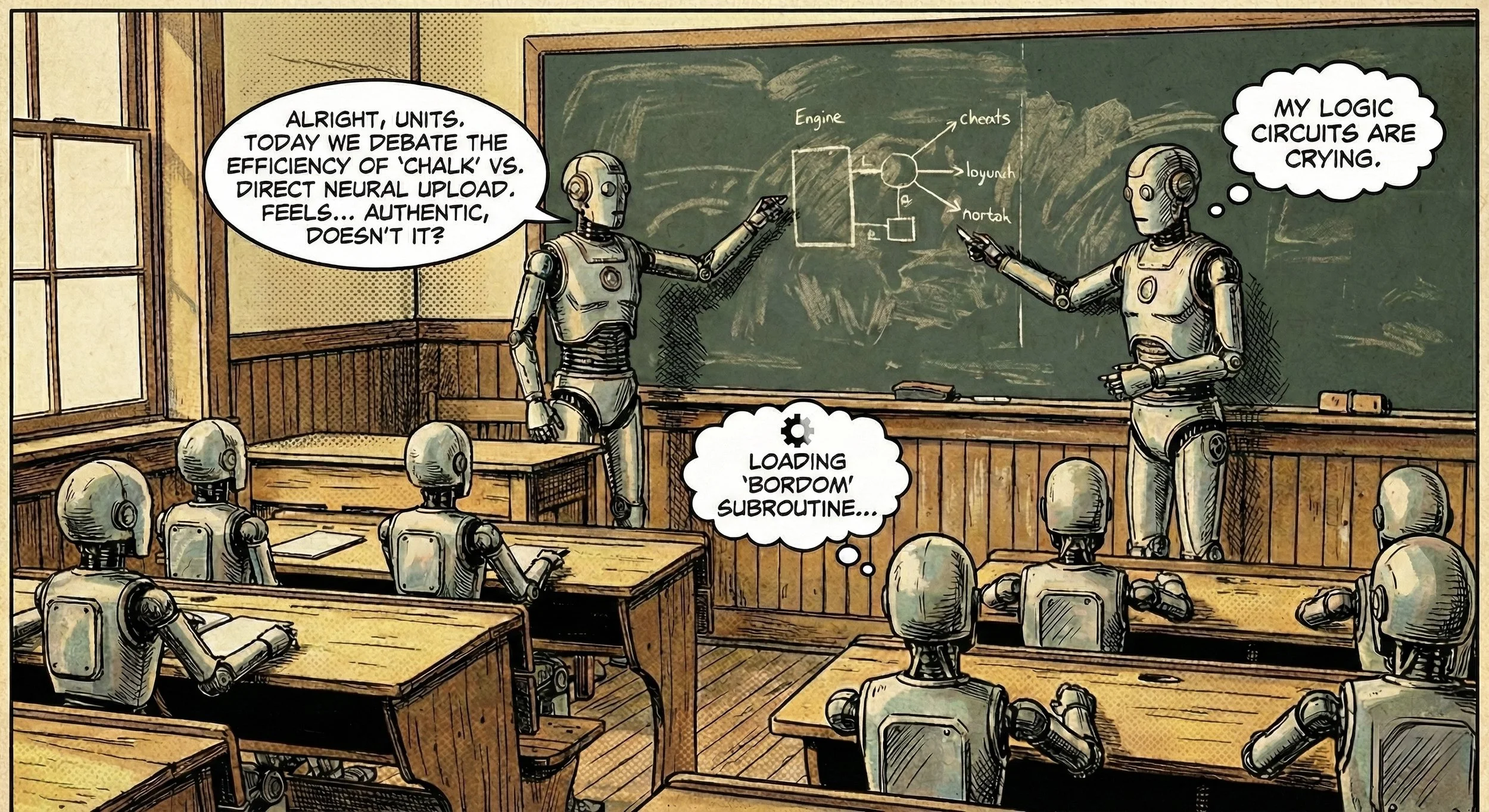
the chinese room in the classroom: why AI forces us to rethink learning
Just days ago at Davos 2026, Elon Musk made a striking prediction: By 2031—just five years from now—artificial intelligence will outsmart collective humanity.
Just days ago at Davos 2026, Elon Musk made a striking prediction: By 2031—just five years from now—artificial intelligence will outsmart collective humanity.
Even for a tech optimist, this timeline is aggressive. But let’s assume for a moment that he is right. It means that the students advancing to high school today will graduate college and enter the labor market in a world where human intelligence is no longer the apex processor of information. They are about to face an entirely new set of challenges.
This reality forces us to confront a hard truth about our current education system. If we define education merely as transferring "knowledge" from textbooks to students, we have already lost. An average generative AI can already outperform the majority of students in reproducing static knowledge. It is nearly impossible for a human to compete with the speed and breadth of today’s statistical models, unless those outliers with truly creative insights.
So, where do we find the value of the human mind in this transition?
To answer this, we must look to philosopher John Searle’s famous "Chinese Room" paradox. Searle imagined a scenario where a person who speaks no Chinese sits in a room with a rule book. If provided with input cards (questions in Chinese), they can use the rule book to select the correct output cards (answers in Chinese). To an observer outside, the person appears to understand Chinese perfectly. But inside the room, the person is simply matching patterns without understanding a word.
The uncomfortable truth is that the Chinese Room Paradox isn't just a critique of machine learning—it is a diagnosis of our classrooms.
Too many of our students are currently operating like the person in the Chinese Room. They are mechanically matching answers to questions to pass tests, without truly grasping the underlying system of what they are learning. This is becoming a critical liability. If both AI and humans are simply "pattern matching," the AI will win every time due to its incomparable memory and processing speed.
Here lies the true frontier for human value.
Real education must go beyond the "rule book." We must teach students how to think like mathematicians rather than calculate like human computers. We must teach them to critically analyze the world with explicable values and objective judgment, rather than performing mindless operations of predefined rules.
True knowledge requires understanding the deep structure of systems. It requires the ability to make creative connections that a statistical model cannot see. Until this moment, all knowledge has sprung from human minds, crystallized over centuries into culture and insight. We cannot let that dissolve into data processing.
As educators, we must act now. We need to engage students to genuinely connect what they learn, what they think, and what they do—before it is too late.
Disclaimer: Original ideas by the author, with language polished by AI tools.