
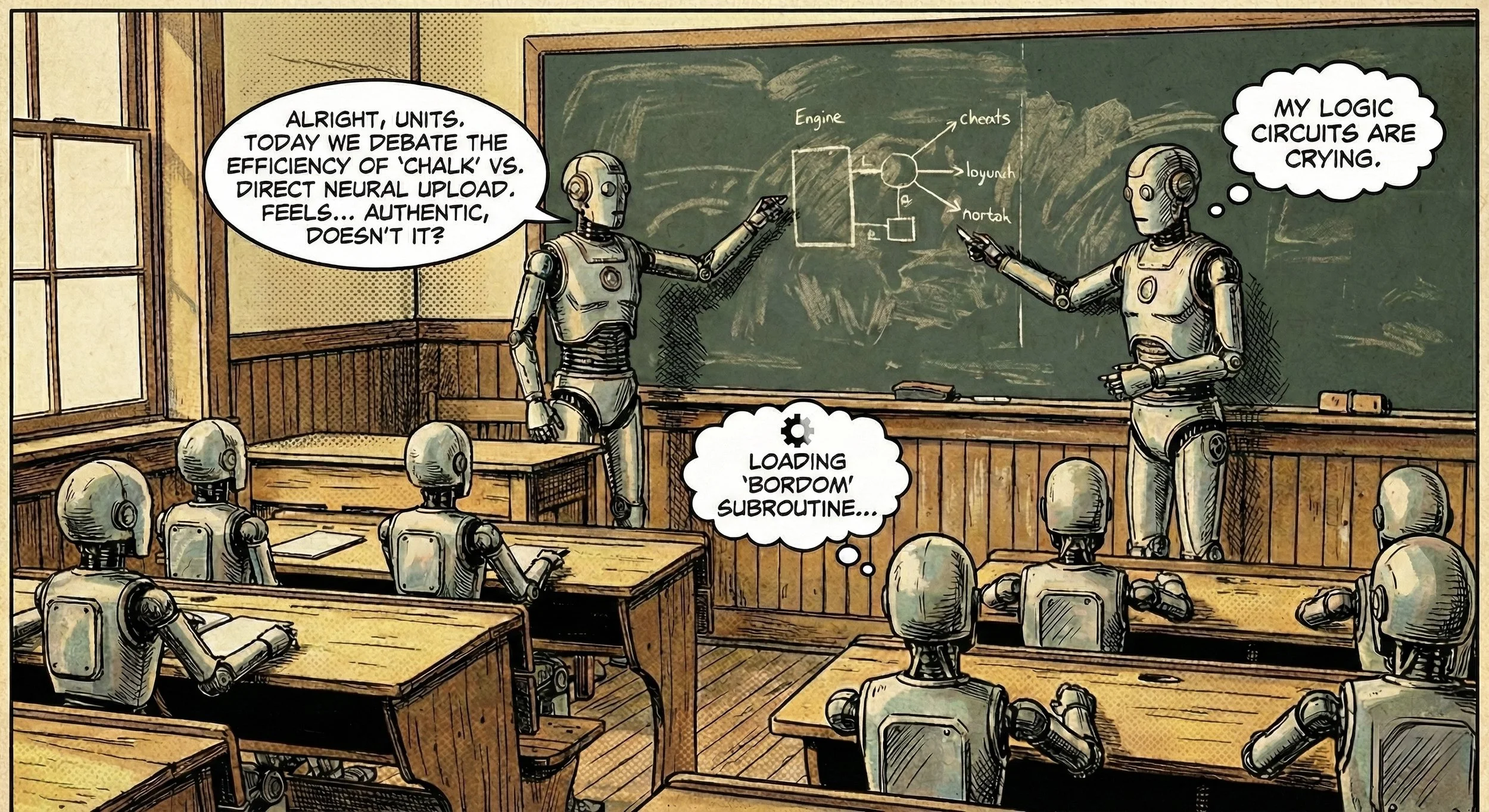
the chinese room in the classroom: why AI forces us to rethink learning
Just days ago at Davos 2026, Elon Musk made a striking prediction: By 2031—just five years from now—artificial intelligence will outsmart collective humanity.
Just days ago at Davos 2026, Elon Musk made a striking prediction: By 2031—just five years from now—artificial intelligence will outsmart collective humanity.
Even for a tech optimist, this timeline is aggressive. But let’s assume for a moment that he is right. It means that the students advancing to high school today will graduate college and enter the labor market in a world where human intelligence is no longer the apex processor of information. They are about to face an entirely new set of challenges.
This reality forces us to confront a hard truth about our current education system. If we define education merely as transferring "knowledge" from textbooks to students, we have already lost. An average generative AI can already outperform the majority of students in reproducing static knowledge. It is nearly impossible for a human to compete with the speed and breadth of today’s statistical models, unless those outliers with truly creative insights.
So, where do we find the value of the human mind in this transition?
To answer this, we must look to philosopher John Searle’s famous "Chinese Room" paradox. Searle imagined a scenario where a person who speaks no Chinese sits in a room with a rule book. If provided with input cards (questions in Chinese), they can use the rule book to select the correct output cards (answers in Chinese). To an observer outside, the person appears to understand Chinese perfectly. But inside the room, the person is simply matching patterns without understanding a word.
The uncomfortable truth is that the Chinese Room Paradox isn't just a critique of machine learning—it is a diagnosis of our classrooms.
Too many of our students are currently operating like the person in the Chinese Room. They are mechanically matching answers to questions to pass tests, without truly grasping the underlying system of what they are learning. This is becoming a critical liability. If both AI and humans are simply "pattern matching," the AI will win every time due to its incomparable memory and processing speed.
Here lies the true frontier for human value.
Real education must go beyond the "rule book." We must teach students how to think like mathematicians rather than calculate like human computers. We must teach them to critically analyze the world with explicable values and objective judgment, rather than performing mindless operations of predefined rules.
True knowledge requires understanding the deep structure of systems. It requires the ability to make creative connections that a statistical model cannot see. Until this moment, all knowledge has sprung from human minds, crystallized over centuries into culture and insight. We cannot let that dissolve into data processing.
As educators, we must act now. We need to engage students to genuinely connect what they learn, what they think, and what they do—before it is too late.
Disclaimer: Original ideas by the author, with language polished by AI tools.