
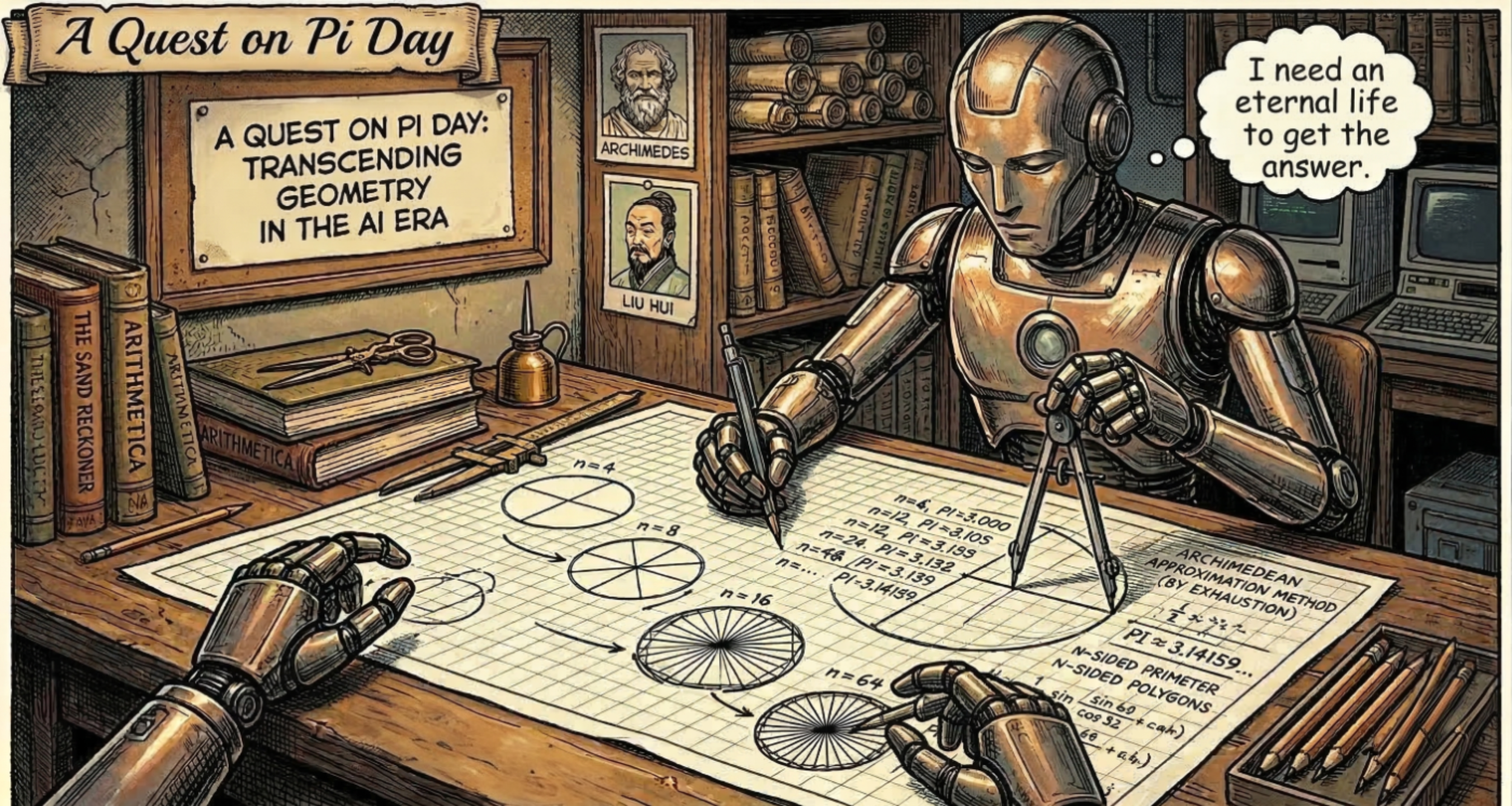
a quest on pi day: transcending geometry in the ai era
Happy Pi Day! Let’s have a historical review on how Pi relates to human civilisation.
Today, March 14, is Pi Day — the most widely recognized date for the general public to commemorate mathematics. While almost everyone associates π with the number 3.14, mathematics learners know its reach extends far beyond the ratio of a circle’s circumference to its diameter. π is a foundational constant of complex analysis, which in turn serves as the theoretical bedrock for modern signal processing. Finding the exact value of π is one of the oldest problems in human civilisation, and exploring its multifaceted nature remains a powerful dynamo in mathematical development.
Nearly all ancient civilisations approached π as a practical engineering problem: how to construct circular objects using rectilinear measurements. If the diameter of a circle was measured precisely, its circumference became frustratingly "immeasurable." Our ancestors settled for approximations—such as 3, the fraction 22/7, or 3.14. Practically speaking, this was sufficient. Because a metaphysically perfect circle cannot be physically constructed, a good approximation satisfied the engineering needs of the day.
However, mathematical minds thought differently, questioning whether π was truly immeasurable even in a theoretical sense. The ancient Greeks posed a famous geometric challenge: using only a compass and an unmarked straightedge, could one construct a square and a circle of the exact same area? It took nearly 2,000 years to prove this mathematically impossible by German mathematician Ferdinand von Lindemann in late 19th century, who at the same time proved that π is transcendental — meaning its value cannot be derived through a finite sequence of arithmetic operations and root-takings. If the discovery of irrational numbers sparked a philosophical crisis for the ancient Pythagoreans, the transcendentality of π would have been utterly paradigm-shattering.
As algebra and calculus matured, mathematical minds began viewing π through entirely new lenses. In antiquity, Greece’s Archimedes and China’s Liu Hui used iterative regular polygons to approximate π. While geometrically elegant, it was computationally exhausting. The birth of calculus in the 17th century introduced infinite power series, a vastly more efficient tool. Over time, increasingly mysterious and efficient series were developed, culminating in the early 20th century with the work of Srinivasa Ramanujan. Ramanujan, who famously claimed his formulae were revealed to him in dreams by a goddess, produced series of astonishing complexity and speed, highlighting a critical concept in modern mathematics: the order of convergence.
Simultaneously, the great Leonhard Euler connected π to the geometry of rotation. By bridging radian notation with complex numbers, Euler transformed geometry into analysis. Through Euler's formula,
$$e^{ix} = \cos(x) + i\sin(x)$$
the wave properties of the physical world could be elegantly represented using complex exponential and trigonometric functions. Waves could now be manipulated, approximated, and compressed analytically, giving birth to modern signal processing.
Today, we know we can never represent the exact, finite value of π. Therefore, the modern challenge is maximising accuracy within a limited computational timeframe. On the other hand, when it gets to an approximated value correct up to billions of digits, whether the resources used to save and manipulate each digit would overflow is another edging problem in computer science. For example, Liu Hui’s dissection method involves a lot of computation involving square root taking. This will definitely cause a huge problem in computers if an algorithm is developed accordingly: The calculated value had to be truncated at some point, creating an accumulative error in the computation as the algorithm goes on. It also drains processing power.
Therefore, computer scientists rely on algorithms built purely on integer addition and multiplication. By expressing infinite series through Linear Fractional Transformations, the computation of π can be reframed into a recurring relationship of matrix multiplications. Because the arithmetic of fractions can be cleanly represented by 2 X 2 matrices, the entire algorithm can run using exact integer matrices, with only a single division operation occurring at the very end to yield the final digits.
Coincidentally — or perhaps consequently — the computational framework driving the neural networks of the current Artificial Intelligence boom is also based on massive matrix multiplication. It is a miraculous, elegant convergence: the exact same structural mathematics used to chase the infinite digits of humanity's oldest geometric constant is now powering the cutting edge of our technological future.
Disclaimer: Original ideas by the author, with language polished by AI tools.